Rediscovery of Patagonia's Ancient Civilization
Last and First MenThe Rediscovery of Patagonia's Ancient Civilization was an archaeological breakthrough that turned the Patagonians’ imagined history upside down. Recovering the record of a lost world did more than enlarge their knowledge: it revealed that their own hard-won civilization occupied ground once conquered and abandoned, and forced them to choose between rejecting the past and allowing it to transform their society. The discovery’s intellectual shock became a political and military crisis, ending in the triumph of the new learning and the reunification of the world.
A civilization hidden in the ruins
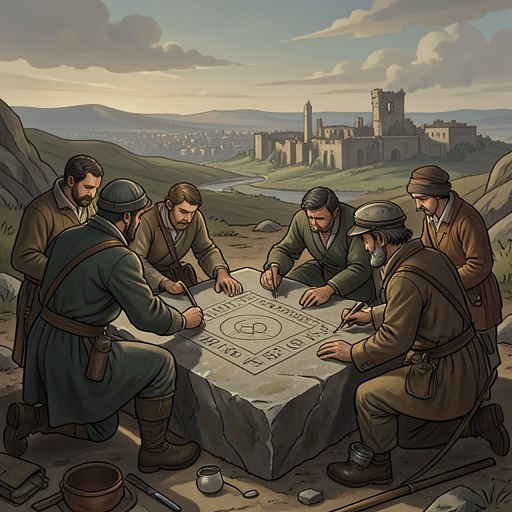
The Patagonians had rejected the ancient religion of fear and, with it, the legend of a remote age of magnificence. They understood themselves as pioneers of the mind. Their homeland offered no relics of the ancient order, while ruins across the older regions had been dismissed as freaks of nature. As natural knowledge advanced, however, archaeologists began reconstructing the forgotten world. The decisive find came in China, in the basement of a shattered pylon: a store of metal plates made from an immensely durable artificial element, embossed with crowded lines of writing.
The objects were not simply inscriptions or isolated curiosities. They were blocks from which books had been printed a hundred thousand years earlier. Further deposits came to light, and researchers gradually deciphered the dead language. Within three centuries they had outlined the ancient culture. What had survived as scattered ruins thus became an extensive historical record, assembled through the recovery of physical artifacts, the interpretation of writing, and the comparison of newly recovered knowledge with the Patagonians’ own investigations.
The past overturns the present
The record’s implications were crushing. The Patagonians learned that the land they had painfully reclaimed from the wild had been conquered long before and subsequently lost. Their achievements in material civilization seemed slight beside those of the ancient world; where the earlier civilization had possessed an empire, the Patagonians had established only scattered settlements. Their natural knowledge had advanced little beyond pre-Newtonian Europe: they had begun to develop a scientific spirit and discarded some superstitions, but had not yet approached the breadth of the inheritance now before them.
The shock was not only a matter of scale. The discovered civilization had been brilliant, but also profoundly unstable: its history showed that irrationality had ultimately prevailed over its achievements. Patagonian researchers did not accept the recovered account as truth simply because it was ancient. They tested it against their own knowledge, handing archaeological findings to physicists and other scientists. This process distinguished the thought and values of Europe and the United States at their zenith from the degenerate products of the First World State. The archive therefore disclosed not a single, unbroken story of progress, but a past in which intellectual achievement and civilizational ruin belonged to the same history.
From historical knowledge to political division
The new knowledge split the Patagonians into opposing camps. One side clung to the belief that it was a satanic lie; the other faced the evidence and argued that Patagonia should use the ancient inheritance. To the reactionaries, the findings were especially painful because they suggested that an earlier race had possessed and spent the very vitality the Patagonians longed for. The progress party accepted that their society lacked the earlier people’s youthful vigor, but proposed that superior sanity could compensate for it. The disagreement was therefore about more than the accuracy of archaeology: it concerned what the present could become once its claimed originality had been disproved.
This dispute produced a physical conflict unprecedented in the Patagonian world. Something like nationalism emerged, and the cultural division acquired a regional form: the more vigorous Antarctic coasts became modern, while Patagonia itself clung to the older culture. Several wars followed. As physics and chemistry advanced in Antarctica, the Southerners developed engines of war that the Northerners could not resist. Within a couple of centuries the new culture had triumphed and the world was once again unified.
Rebuilding with an inheritance
The victory of the new learning altered the material organization of society. Wind and water began generating electricity; extensive mining sought metals and minerals no longer available at easy depths; and steel entered architecture. Electrically driven aeroplanes were built, though without real success. The failure was telling: even after recovering knowledge of a far more advanced civilization, the Patagonians could not simply reproduce its powers. Their lack of oil and coal hampered them, and volcanic energy, which the more resourceful ancients had never truly mastered, defeated the Patagonians as well.
The discovery thus changed both the Patagonians’ account of the past and the limits they recognized in their present. Ancient remains had once been mistaken for natural oddities; once read, they made the apparent pioneers heirs to a history of conquest, brilliance, waste, and collapse. Yet inheritance did not provide a ready-made route back to ancient greatness. The recovered past could be tested, interpreted, and used to reorganize society, but its technologies and failures could not be separated from the conditions that had produced them. The rediscovery’s lasting force lies in this double reversal: it displaced Patagonia from the beginning of human history without making the past a simple model for the future.